
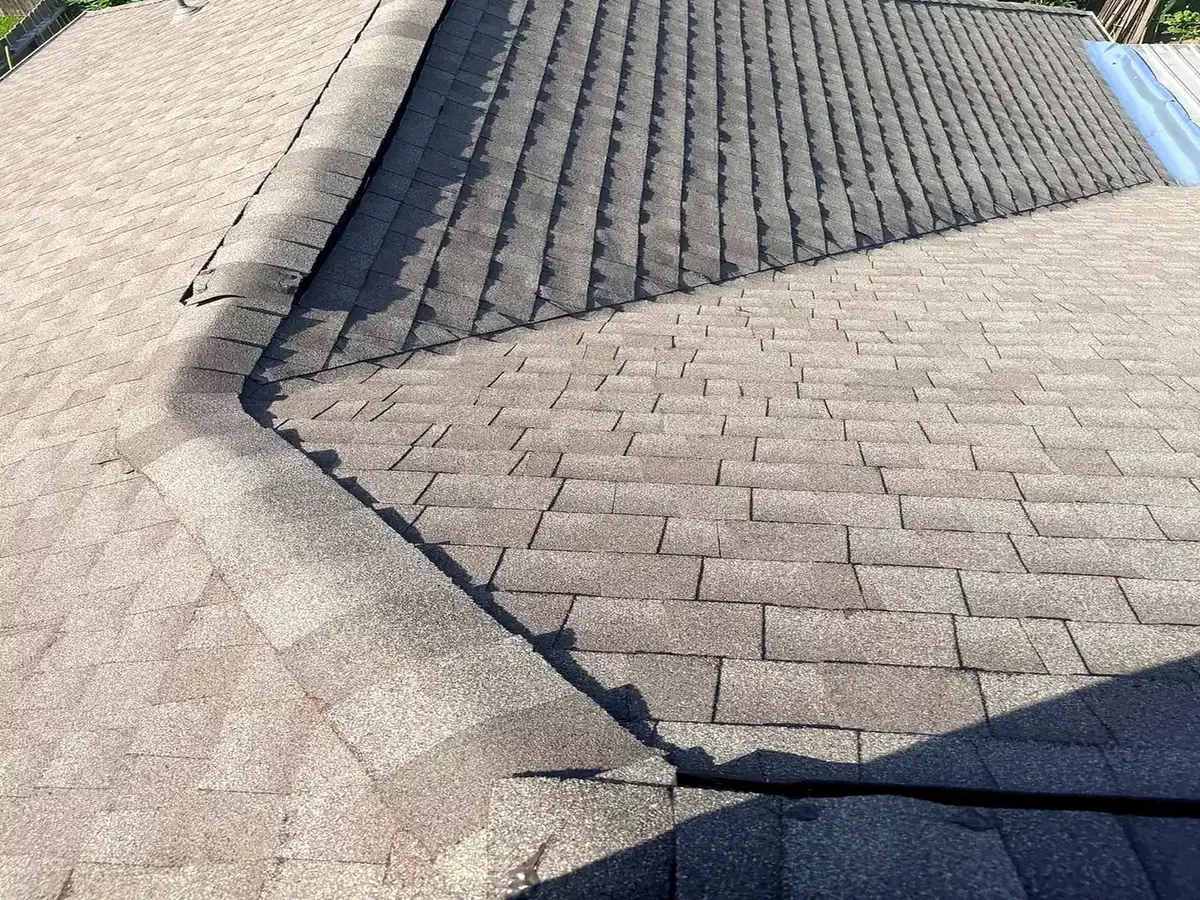
What wind does to a shingle roof
Asphalt shingles are held down by nails and by a strip of factory sealant that bonds each shingle to the one below it. Wind damage happens in a predictable order:
- The seal breaks. Gusts get under the edge of a tab and pry it up. Older shingles, whose sealant has dried out in the Texas heat, let go first.
- The tab creases. A lifted tab bends back on itself and leaves a horizontal crease. Even if it lies flat afterward, it's no longer sealed and will lift again.
- The shingle tears off. Repeated lifting pulls the shingle past its nails, exposing the felt or synthetic underlayment — or bare decking.
Edges take the most force: rakes, eaves, hips and ridge caps. That's why a roof often loses its ridge cap or a row along the edge first.
Signs you need a shingle repair
- Shingles, ridge cap pieces or granules in the yard, driveway or gutters
- Dark patches or a different color on the roof where shingles are missing
- Tabs that look raised, wavy, or show a straight crease line
- Drip edge or flashing bent outward or flapping
- Exposed nail heads or underlayment visible from the ground
Check from the ground or an upstairs window. If you see bare decking or rain is forecast, ask for emergency tarping first.
How a proper shingle repair is done
Replacing a shingle isn't just sliding a new one in. A careful roofer breaks the seal on the course above, removes the damaged shingle and its nails, slides in the replacement, nails it in the right zone, and hand-seals the tabs above and below with roofing cement so the area is bonded again — especially important if the repair happens in cool weather when new sealant strips won't activate on their own.
Creased tabs on an otherwise sound shingle can sometimes be re-sealed, but a deep crease usually means replacement. Missing ridge caps are replaced with matching cap shingles, and bent drip edge is re-fastened or replaced.
The shingle-matching problem
Shingle colors fade with sun exposure and product lines change. On a roof that's 10–20 years old, a new shingle rarely matches perfectly, and some older lines are discontinued. A roofer can often source the closest available match; on very visible slopes, some homeowners choose to replace the whole slope for a uniform look. In HOA communities such as Shadow Creek Ranch and Southern Trails, ask whether a mismatched repair is acceptable.
Wind ratings: what to ask for
Shingles are tested for wind resistance, and higher-rated products and installation methods hold up better on the Gulf Coast. When repairing or replacing, ask your roofer about:
- Wind-rated shingles — many architectural shingles carry ratings around 110–130 mph when installed to the manufacturer's high-wind specifications.
- High-wind nailing — typically six nails per shingle instead of four.
- Starter strips at eaves and rakes with sealant, so the first course can't be peeled up.
Closer to the coast — including parts of League City — windstorm insurance rules can require specific installation and inspection. Ask before work starts.
Typical costs
| Repair | Typical range |
|---|---|
| Replace a few missing shingles | $300–$600 |
| Larger area or multiple slopes | $600–$1,200+ |
| Ridge cap repair | $250–$700 |
| Drip edge re-fastening/replacement | $200–$600 |
General ranges only — your roofer prices after inspecting. If the damage came from a named storm or widespread wind event, also read storm & hail damage repair for insurance documentation tips.